CANON THE OBJECTIONS HANDBOOK
The hardest questions, in full
We do not argue the adjective; we show the mechanism.
Nexusland is a cultural and worldbuilding project by Roman Kotlar. It is not a country, a government, a bank, a religious authority, or a provider of legal status. It has no live product yet. Much of what follows is doctrine meant to endure rather than a record of things already delivered, and where an answer describes a plan rather than a fact, it says so. None of the bodies named below exists yet. Today the project is run by one person. This is the written design for how it is meant to work.

Nexusland Conceptual Art · CONCEPT
THE METHOD
Fair part. Answer. Test.
Each answer points to the structure that makes the feared thing hard or impossible — and ends with a test you can check for yourself.
The questions are written in their sharpest honest form, not softened into something easier to answer. Where a worry is fair, we say so. Where we could fail, we name how.

Nexusland Conceptual Art · CONCEPT
- The fair partNames what is legitimate in the question.
- The answerResponds, grounded in a mechanism rather than a reassurance.
- The testTells you what to verify — or what would prove us wrong.
CANON WHAT IS THIS, REALLY?
What is this, really?
Seven first suspicions, each taken seriously.
Open any question to read the fair part, the answer, and the test.
Is this a cult?
The fair part. Any project with a strong moral vocabulary, a founding figure, and a real sense of belonging deserves this question. Cults are real, and they form exactly where meaning, identity, and a leader meet.
The answer. A cult concentrates power in a person and punishes leaving. Nexusland is built to do the opposite — by rule, not by promise. Leadership is bounded and may not be made to appear greater than the system (the Anti-Personality-Cult Protocol); serious disputes go to an Arbitration Council; and any Resident may leave at any time, without shame or penalty. We do not ask you to believe we are not a cult. We point to the limits and ask you to check them.
The test. Look for the three marks of high control. Can you leave freely? Is power concentrated in one unaccountable person, or bounded and answerable? Does belonging cost money? If any answer drifts the wrong way, that is a failure to name — tell us where.
Is this a religion in disguise?
The fair part. Nexusland says plainly that its moral foundation is inspired by the Christian moral inheritance, and it uses words like “Ideals” and “Narthex.” It is reasonable to ask whether that makes it a faith dressed up as a platform.
The answer. Nexusland knows what it is and is not: a cultural and civic project with a stated moral direction — not a church, not a substitute for faith, and not a maker of doctrine (Ideal 9). It is open in welcome and requires no confession from anyone who enters. The optional Narthex Portal helps people find real, verified Church life run by actual clergy; it makes no religious claims of its own and may never stand in for confession, the sacraments, or the Church.
The test. Ask what you must believe in order to belong. The honest answer is: nothing. If Nexusland ever required a profession of faith to join, ranked people by piety, or claimed sacred authority over anyone, it would have broken its own foundation.
Is there a token or a coin?
The fair part. “Resident,” “House,” “rank,” “Curator” — to an ear trained on speculative projects, that sounds like the setup for a sale. The pattern-match is fair; plenty of projects have used exactly this language to sell speculation.
The answer. There is no Nexusland token, coin, or investment instrument, and there will not be one. Belonging and rank are never bought, sold, or traded. If anyone sells you a Nexusland coin, share, or rank, it is a scam using our name. Words here are meant to stay answerable to reality (Ideal 8): “Resident” is a name for belonging, not a financial position.
The test. There is nothing to buy and no upside to trade. If that ever changes — if a coin appears, or status becomes purchasable — every claim in this document is void.
Is this an MLM or a pyramid scheme?
The fair part. Communities with ranks and progression can hide a recruitment engine, where your standing or income depends on the people you bring in. That structure does real harm, and it is worth ruling out.
The answer. No one in Nexusland earns money or rank by recruiting other people. There are no referral payouts and nothing to sell. Rank marks growth, reliability, and service — never something money can simply buy — and any compensation is meant to run on a transparent, externally anchored formula, paid in the open, with no side channels (Ideal 5: no one is reduced to an instrument of growth).
The test. Follow the money and the status. If neither flows from recruitment, the mechanism of an MLM is simply absent. Ask to see how contribution and pay actually work; it is meant to be public.
Is this a personality cult around the founder?
The fair part. The project began with one person and a strong vision. That is the soil a personality cult grows in, and right now the founder is its most visible face.
The answer. The founder’s role is deliberately bounded, and a standing rule — the Anti-Personality-Cult Protocol — forbids making any leader, founder included, appear greater than the system; official communication points back to the Ideals, the Houses, Residents, and real work, never to a personality (Ideal 20: self-exaltation must never become the ruling spirit).
The test. Watch where the project points attention — to the work and the many, or to one face. Watch whether the founder is held to a higher standard or a softer one (Ideals 27–28).
Is this a country trying to escape the law?
The fair part. There is a world map, ten symbolic cities, talk of future physical hubs, and the word “Resident.” Several well-funded projects do explicitly aim at sovereignty, so the suspicion is grounded.
The answer. Nexusland is not a country and does not pretend to be one (Ideals 9, 31). The map is symbolic — a picture of belonging, not territory, sovereignty, or property — and “Resident” grants no immigration status or legal standing. Wherever Nexusland ever builds anything physical, it lives under that place’s laws; it governs its own community standards and nothing more, and claims no immunity from any lawful authority.
The test. Look for the tell of a sovereignty project: claims of legal exemption, passports, borders, its own courts over civil or criminal matters. Nexusland sends those matters to real jurisdictions on purpose (Ideal 25). If it ever claimed otherwise, hold it to this page.
Is this vaporware? Will anything real ever get built?
The fair part. Today there is a body of writing and no live product. “All manifestos, no product” is a fair thing to say about a project at this stage, and many such projects never ship.
The answer. This is true, and we say so: there is no live product yet, and much of what exists is doctrine meant to endure rather than proof of delivery. Nexusland is built deliberately, by a stated Law of Patience — it would rather stay quiet than speak one phase ahead of the truth, and it will not fake traction to answer the charge. The honest reply is to let shipped work speak over time, against a public roadmap.
The test. Judge by what actually exists and ships, in the order the project publishes — and treat any hype, invented metrics, or “false maturity” as the real warning sign, since avoiding exactly that is a stated value.

CANON THE MORAL ROOT
Respect, not belief
Ask what you must believe in order to belong. The honest answer is: nothing.
We’re a cultural and civic project with a stated moral direction, open to everyone. We’re not a church and don’t claim to replace one.
Nexusland Conceptual Art · CONCEPT
CANON THE MORAL ROOT · WORD FOR WORD
The moral root
Five answers, given word for word from the Handbook.
The Christian moral inheritance is named openly. The welcome is genuine. What is asked is respect, not belief.
Your foundation is openly Christian. Isn’t “open to all” a bait-and-switch?
The fair part. A project can say “everyone is welcome” while quietly building a space where only one kind of person truly fits. If the moral root is Christian, it is fair to ask whether the welcome is real.
The answer. The Christian moral inheritance is named openly, on the cover of the founding Ideals — it is the source of the project’s direction, not a hidden agenda. The welcome is genuine: everyone is invited, with no test of denomination and no confession required of anyone who enters (the Preamble). What it asks in return is not a creed but respect — respect for the Christian inheritance the project is built on, and for the members who hold that faith. You are free not to believe; you are asked to honor those who do. And of everyone, finally, it asks a shared direction — truth over manipulation, dignity over utility, mercy over cruelty.
The test. A bait-and-switch would show up as a hidden requirement: a belief you must hold, a confession you must make, a penalty for not sharing the faith. There is none — what is asked is respect, not belief. Measure the welcome by what is actually required to belong.
Are you trying to convert me?
The fair part. When a project carries a moral and spiritual vocabulary, people reasonably worry that “community” is a funnel toward belief, and that the friendliness is instrumental.
The answer. No. Nexusland is not a church and makes no religious claims of its own (Ideal 9). It asks for honesty, seriousness, and moral restraint — not agreement in matters of faith — and conscience is explicitly to be respected (Ideal 15). The optional Narthex Portal exists for people who go looking for real Christian Church life; it points them to actual Christian parishes and clergy, and is barred from gamifying belief or standing in for the Church itself. Nothing pushes faith on anyone who does not seek it.
The test. You can be a full Resident, at any level, without adopting any belief, and nothing about your standing depends on faith. If participation ever quietly required belief, that would be a violation to name.
Is this a Christian theocracy, or Christian nationalism?
The fair part. “Christian moral foundation” plus “civilization” plus a map can read as a political program — a state ordered by one religion. That combination has a real and troubling history.
The answer. Nexusland is explicitly not a church and not a state, and may not become either (Ideal 9). Its leadership is barred by rule from transforming it into a church, state, bank, party, or cult, and from using sacred language for power (Operating Structure: Steward limits). It claims no nation and no sovereignty, and submits all civil and criminal questions to lawful authorities (Ideals 25, 31). A moral direction is not a theocracy; a symbolic map is not a country.
The test. A theocracy enforces religion through power and law. Nexusland holds neither religious authority nor legal power over anyone, by design. If it ever tried to grant legal status, claim sovereignty, or rule by sacred title, it would be breaking its own foundation.
Does your foundation exclude or demean LGBTQ people, or non-Christians?
The fair part. The Ideals affirm the family founded on the union of man and woman. People reasonably ask whether that language is a door closing on them, or a license for contempt.
The answer. Two things are true at once, and Nexusland holds both without collapsing either. First: every person carries an inherent dignity that may never be reduced or humiliated (Ideal 2); the Ideals authorize no contempt, no coercion, and no unlawful discrimination (Ideal 13), and nothing in them permits the denial of equal human dignity (the Final Declaration). Everyone is welcomed under that same guarantee, and each person stays free to make their own choices about their own life. Second, and just as honestly: the Ideals carry a particular vision of the good — including the family founded on the union of man and woman — and Nexusland does not claim to share or endorse every set of values as its own. Respecting a person is not the same as adopting their convictions, and the project will not pretend otherwise in order to seem agreeable. To hold our own values openly, while refusing contempt and discrimination, is the honest position — not a softer one and not a harder one.
The test. The line that matters is conduct. Is anyone treated with contempt, coerced, or unlawfully excluded? That is forbidden, and where it happens it is a failure to correct — name it. Holding a different view of the good, stated without malice, is not mistreatment; the foundation’s whole task here is to keep the two from ever being confused.
Are you politically captured — left or right?
The fair part. A project with strong moral language is easily read as a partisan flag, and people on every side will try to claim it or cast it as the enemy.
The answer. Nexusland’s commitments are moral, not partisan: dignity, truth, mercy, restraint, care for the vulnerable, peace over contempt. These do not map onto a party, and the project refuses to be pulled into culture-war combat or to mock anyone for their politics. Its standards are about behavior and respect for the foundation, applied equally to all — not about identity or political alignment.
The test. Watch whether the project enforces conduct evenhandedly, or punishes people for their political tribe. Capture would look like one side getting a pass and the other getting the door. The rule is the same rule for everyone.
CANON POWER AND THE FOUNDER
No one greater than the system
The limits are written into structure, not sentiment.
The Ideals stand above every person, vote, leader, and investor. A standing rule — the Anti-Personality-Cult Protocol — forbids making any leader, founder included, appear greater than the system.
- Bounded leadershipThe Steward may not change the Ideals or weaken the Immutable Core.
- A council for disputesSerious cases and appeals go to the Arbitration Council, which decides with written reasons.
- Attention on the workOfficial communication points back to the Ideals, the Houses, Residents, and real work, never to a personality.
- Honest about todayThis worry is real today and is meant to shrink as the structure is built.

Nexusland Conceptual Art · CONCEPT
CANON POWER, THE FOUNDER, AND MONEY
Power and money
Who holds power, what happens after the founder, and what money can never buy.
The two answers about money are given word for word.
Doesn’t the “anti-cult” language just hide that the founder controls everything?
The fair part. Right now the founder did write the canon and does steer the project. A protocol is only words; it is fair to ask whether the limits are real or decorative.
The answer. The limits are written into structure, not sentiment. The Steward — founder included — may not change the Ideals or weaken the Immutable Core, may not seize the Treasury or override the safety body or the Legal Hall, and may not rule by sacred title (Operating Structure). The Ideals stand above every person, vote, leader, and investor.
The test. The honest version of this worry is real today and is meant to shrink as the structure is built: as governance bodies and succession come into being, control disperses. Watch that it does. If a role is genuinely too vague, that is a flaw to fix in the open, not to defend.
What happens when the founder dies, leaves, or burns out?
The fair part. A project that depends on one person has a single point of failure. “What if the founder is hit by a bus” is not a gotcha; it is basic due diligence.
The answer. The project’s core promise is to outlive its founder, and the structure is built for it: a succession plan that is part of the canon, and bounded roles, so no single person is irreplaceable. In the gravest case, the rule is grief first, continuity second — execute the succession, protect the family and the community, and never deify anyone in death.
The test. Ask to see the succession plan once it is published; until then, count this as a promise, not a fact. If a project cannot tell you what happens the day its founder leaves, that is the failure. Nexusland’s answer is meant to be on paper before it is needed.
What stops a future leader from corrupting the mission once you’re gone?
The fair part. Even an honest founder cannot guarantee their successors. Many institutions drift far from their founding purpose. Guarding against the future is harder than guarding the present.
The answer. The deepest safeguard is the Immutable Core — the part of the Ideals that can never be amended, traded away, or weakened, only interpreted; it cannot be changed by any Steward decision, House vote, Resident vote, or temporary majority.
The test. Ask what a determined bad-faith successor could do — and against what. Mission drift is named as the gravest internal failure, with its own protocol.
How do you make money without manipulating me?
The fair part. “Humane platform” pitches usually collide with how platforms actually earn — attention, ads, and data. If the business model is the same as everyone else’s, the values are decoration. It is fair to press here.
The answer. The model is bound by what the project refuses to do: it never sells, rents, or brokers your data; never runs surveillance advertising; and never optimizes for your time-on-app (data commitments, nexusland.app). Beyond those refusals, the working commitment is to do everything in its power to avoid tracking you at all — cutting any tracking to the necessary minimum rather than the convenient maximum. Revenue is meant to come from honest exchange — value people choose to pay for — on the principle of trust before monetization: a serious project is not built by promising value before value is lived. The specific revenue lines are still being worked out, in the open, and are constrained by these refusals, not the other way around.
The test. The tell of a manipulative model is that the company profits when you lose — more time, more data, more compulsion. Ask whether Nexusland’s income depends on holding your attention. It is built so it does not; a future revenue line that required surveillance or compulsion would be off the table by rule.
Is belonging something I have to buy?
The fair part. Many communities sell status — pay for the badge, the tier, the access. People reasonably ask whether “Resident,” or a higher rank, is really just a purchase.
The answer. Belonging is not for sale, and rank is never something money can simply buy. Standing marks growth, reliability, and service, not spending. There is no purchased status and no pay-to-rank. (This is also why there is no token and no MLM — see the answers above.)
The test. Ask whether you can buy your way to a higher rank, or to belonging itself. If you cannot, the mechanism of paid status is absent. If that ever changed, this page would be broken.
THE FEED, YOUR DATA, AND THE AI · HORIZON
Declared, not surveilled
This is a hypothesis, and we say so.
There is no live product yet. The principles are fixed — declared over surveilled, less tracking rather than more, only the necessary minimum — but the concrete mechanics will be settled when the feed is actually built, in the open.
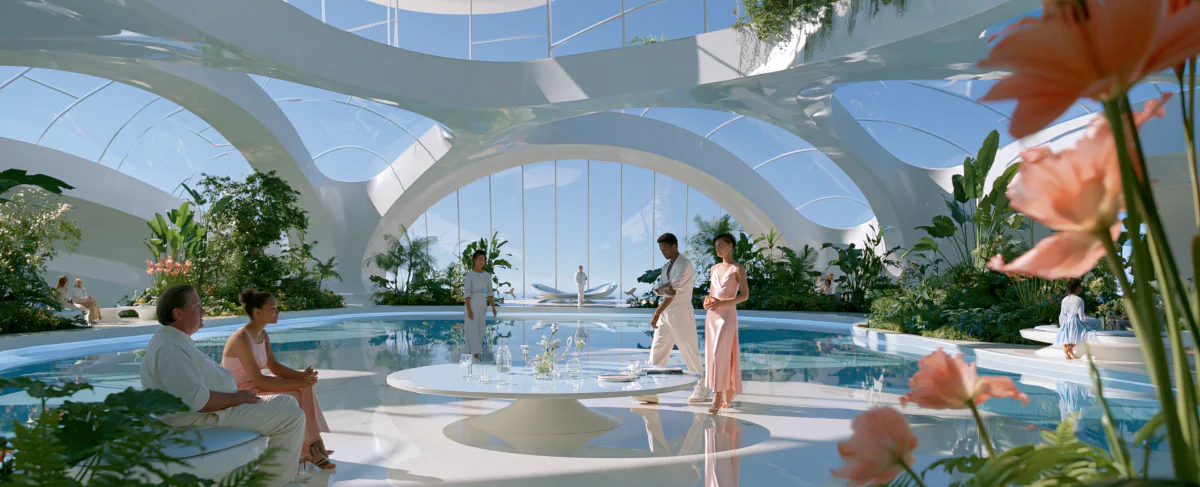
Nexusland Conceptual Art · CONCEPT
HORIZON THE FEED, YOUR DATA, AND THE AI
The feed, your data, the AI
Four questions about a product that does not exist yet.
Judge it by the real thing when it exists.
Your whole pitch is a “non-manipulative feed.” Isn’t that impossible — or just boring?
The fair part. Every feed claims to serve you; in practice they optimize for attention. And there is a real worry that a feed which refuses those tricks would simply be dull and lose to the ones that don’t. This is the project’s central unproven bet, and it deserves the doubt.
The answer. The distinction is declared, not surveilled. A surveillance feed watches your behavior, builds a hidden profile you cannot see, and optimizes it to keep you engaged. A declared feed is shaped by what you openly tell it you care about — a model that belongs to you, visible and editable, optimized for your goal. This is still personalization; in fact it is sharper, because it is built on what is true to you rather than guessed from what held your attention. Content is ranked by quality and safety, the same for everyone, never by how long it holds you.
The test. This is a hypothesis, and we say so. The principles are fixed — declared over surveilled, less tracking rather than more, only the necessary minimum — but the concrete mechanics will be settled when the feed is actually built, in the open. The commitment is to do everything in our power to keep it honest; judge it by the real thing when it exists, and by whether the model it builds of you is one you can see and edit, or one hidden from you.
What do you collect about me, and how can you personalize without surveilling me?
The fair part. “Personalization without surveillance” can sound like a contradiction, and vague privacy promises are cheap. Asking exactly what is collected is the right level of specificity.
The answer. The default is the least we need, never the most we can take. Your experience is built from what you declare — the interests, sources, and people you choose — and from explicit feedback (“more like this,” “less,” “hide”), all visible and editable by you. We do not turn what you lingered on into a hidden behavioral profile; at most, an observation becomes a visible suggestion you confirm, never a silent inference. Your data is yours: to see, to take with you, and to truly erase.
The test. Ask whether the model of you is one you can open, read, and change — or one kept from you and used against your interest. Visible-and-editable is the line. Today, with no live product, the most collected is the email address you leave for a letter; the policy is meant to expand honestly as products exist.
Won’t a “wholesome” feed just become an echo chamber, or soft censorship?
The fair part. Curation always raises this: who decides what is “good,” and does a safety filter become a way to quietly silence views someone dislikes? Both echo chambers and stealth censorship are real failure modes.
The answer. There are two safeguards. First, the model that shapes your feed is yours — you declare and edit it — so the curation answers to you, not to a hidden agenda. Second, safety is treated as a threshold against harm, applied the same for everyone and kept separate from quality ranking — not as an instrument of ideological censorship; the project explicitly warns against using “safety” as a weapon. Standards are about conduct and harm, not about silencing disagreement, which is meant to be handled with calm and proportion (Ideal 32).
The test. Watch for the two tells: a feed you cannot widen or steer (echo chamber), and “safety” actions that fall only on one viewpoint (censorship). Both are failures to name. The named criteria for ranking and filtering are meant to be public, not secret.
Will an algorithm decide things about me? Where does AI stop and a human start?
The fair part. “AI-assisted” decisions about people often mean the machine effectively decides and a human rubber-stamps it. It is fair to want to know exactly where automation acts and where it does not.
The answer. Honesty first: in the design, AI does real work, and some of it is automated — sorting, classifying, flagging, and triaging at a scale humans cannot match. What it does not do is sit in judgment over a person. In the most consequential and sensitive matters — anything that significantly affects someone’s standing or access, and any dispute that functions like a hearing — the decision is reserved to accountable humans; AI’s role there is to classify and prepare the material for human review, not to rule. The principle holds even where the tooling is automated: AI is an instrument under human judgment, never an authority over a person.
The test. Ask, for any decision that genuinely affects a person: is there a named human accountable for it, and a real route of appeal to a human? Automated sorting in the background is fine; an algorithm quietly deciding your standing, your access, or the outcome of a dispute is not. The commitment is that the consequential call is always human.
CANON PEOPLE AND FAIRNESS
Conduct, not agreement
The line is what you do, not what you think or say.
Disagreement is not a violation, and criticism is not disloyalty. Enforcement is tied to conduct — never to identity, belief, or politics — and the same rule applies to everyone, leaders included.
- Written reasonsA takedown with no reasons given is a mark of abuse.
- A real appealTo a human, and to a council that decides with written reasons.
- Equal applicationThe same rule for insiders and outsiders — including against the powerful.

Nexusland Conceptual Art · CONCEPT
CANON PEOPLE, FAIRNESS, AND TRUST
People and fairness
Who can be removed, who may disagree, who is owed care — and why believe any of it.
The last question is the most honest one, and the right one to end on.
Who decides what gets removed, or who gets removed — and what stops that becoming a tool for silencing people?
The fair part. Any platform that can take down content or take out people holds real power over them, and that power is easy to abuse — to bury criticism, settle scores, or push out the unwanted under a friendly name. Asking who holds it, and what checks it, is exactly right.
The answer. Enforcement is bounded and answerable, not personal. It is tied to conduct — never to identity, belief, or politics — and the same rule applies to everyone, leaders included (Ideals 27–28). Routine safety is meant to sit with the Guard — moderation, child protection, incident response — and serious cases and appeals are meant to go to the Arbitration Council, which decides with written reasons. No single person holds unchecked power to remove others, and the founder or a future Steward is not exempt from the rule. The purpose of the power is to protect people and the Immutable Core from those who come to break them — nothing more.
The test. Watch for the marks of abuse: takedowns with no reasons given, no human appeal, or a rule that bends for insiders and falls hardest on outsiders. Written reasons, a real appeal, and equal application — including against the powerful — are the checks. If they erode, that is the place to say so.
What if I disagree with the Ideals, or want to criticize Nexusland publicly? Am I pushed out?
The fair part. A community with a strong moral core can quietly make belonging depend on never questioning the project. If criticizing Nexusland — or simply disagreeing with parts of the Ideals — costs you your place, then the openness is a performance.
The answer. Disagreement is not a violation, and criticism is not disloyalty. You can question the Ideals, argue with decisions, and criticize Nexusland in public without losing your standing — the project asks respect for other people and for the canon, not unanimity of opinion. What it guards against is conduct aimed at breaking the community or hollowing out the Immutable Core; the line is what you do, not what you think or say. Even in sharp disagreement the asked-for posture is calm and proportion (Ideal 32), and leaders are owed less deference under criticism, not more (Ideals 27–28).
The test. Ask whether open critics of Nexusland keep their place, or quietly lose it. A project that can be argued with from the inside is healthy; the warning sign is when dissent and disloyalty start to be treated as the same thing. The line that must hold is conduct, not agreement.
A meaning-community attracts vulnerable people. What is your duty of care — and what about a predator, or a death?
The fair part. Communities built around meaning draw people who are searching, lonely, or fragile — and that is exactly where abusers look, and where a tragedy hits hardest. Treating this as a serious, foreseeable risk is the only honest posture.
The answer. The vulnerable are owed particular care as a foundational commitment (Ideal 16), and a dedicated safety body — the Guard — is meant to hold moderation, child protection, incident response, and crisis handling. Child safety is treated as the gravest case, especially anywhere spaces function as schools. Nexusland is not a court and claims no final judgment over anyone; civil and criminal matters go to lawful authorities (Ideals 24, 25, 31). In a crisis, the rule is care for the affected person first, the same standard applied to insiders as to anyone, and no shielding of a person because of their standing.
The test. Ask what happens when the worst occurs: is there a real safety function, does harm go to lawful authorities, and is a powerful person held to the same line as anyone? A project that has not thought about its predators and its tragedies in advance is the one to worry about.
You’re one person with a manifesto. Why should I believe any of this becomes real?
The fair part. This is the most honest question of all, and the right one to end on. Everything above is, today, a set of commitments and structures on paper — not a track record. Belief should be earned, not requested.
The answer. You shouldn’t believe it on faith — and the project says so. The reason to take it seriously is not the promises but the mechanisms: the things written here are checkable, and most end with a test or a falsifying condition. Words are meant to stay answerable to reality (Ideal 8); the project would rather move slowly and honestly than overclaim (the Law of Patience). The honest standard is the one this whole handbook asks for — judge Nexusland by what it actually does, against what it wrote down.
The test. Hold this document up against reality over time. Where the mechanisms are real and the conduct matches, trust is earned. Where they are not, this page becomes the evidence against the project. That is the deal, and it is meant to be.
NOT ANSWERED HERE YET
Six answers we hold back
We would rather stay quiet than speak one phase ahead of the truth.
The Handbook also asks the six questions below. Their answers describe legal and financial structures that are still a working plan, not yet a fact. We will publish them here when every one of our documents says the same thing.
- Is this just a tech-founder’s vanity project?
Topic: who owns the mission.
- Is the founder getting rich off this?
Topic: the founder and money.
- What happens when an investor shows up with strings attached?
Topic: outside capital.
- Where does the money go — and how would I know if it were misused?
Topic: money in the open.
- What if I want to leave? Do I lose everything I made?
Topic: what you keep when you leave.
- If contributions are volunteer gifts, why isn’t Nexusland open-source?
Topic: volunteer work and a closed product.
THE DEAL
Do not take our word
Look at the structure, and check it.
Where Nexusland is what it claims, the mechanisms will hold. Where it is not, they are how you will catch it. This handbook will grow as the questions do; what it will not do is soften them.

Nexusland Conceptual Art · CONCEPT